Research Interests
I have a broad interest in ecology, with a focus on animal movement and spatial ecology, especially migration and dispersal. I am also fascinated by human-wildlife and animal-plant interactions, and methods and technologies used to monitor biodiversity.
Animal movement in the Anthropocene
The COVID-19 Bio-Logging Initiative
Many researchers around the world have been curious to know whether animal movement patterns changed in response to altered human mobility patterns that occurred during lockdown. This led to the launch of COVID-19 Bio-logging Initiative, led by a committee under the umbrella of the International Bio-Logging Society, bringing together the global wildlife tracking community.
I co-lead two sub-projects within this initiative. The first focusses on understanding if and how raptor movement patterns were impacted by changes in human mobility during lockdown, and the second investigates whether habitat selection in gulls was different in 2020 compared to non-lockdown years. Both projects are highly collaborative and include a large number of researchers contributing data and expertise.
In a sub-project focused on large terrestrial mammals movements, we found that they occurred 36% closer to roads during lockdown, and that their movement distances over ten days were 73% longer during strict lockdowns compared to the same period one year earlier. This work is published in the journal Science and I wrote about it for The Conversation.
How does migration change with age?
Following a bird’s first migration is difficult, particularly for small birds that must be tracked using archival data loggers. Juveniles typically have lower survival rates than adults and they disperse away from their natal territory, making tag retrieval problematic. Cyprus wheatears have relatively low juvenile dispersal and high survival rates though, and this means that we can recover geolocators carried by juveniles more easily than in almost all other passerine systems. We compared the first migrations of Cyprus wheatears against those of experienced birds, and by repeat tracking the juveniles as adults. Understanding how migration and dispersal changes with age is an important component of understanding how populations might adapt to environmental change.
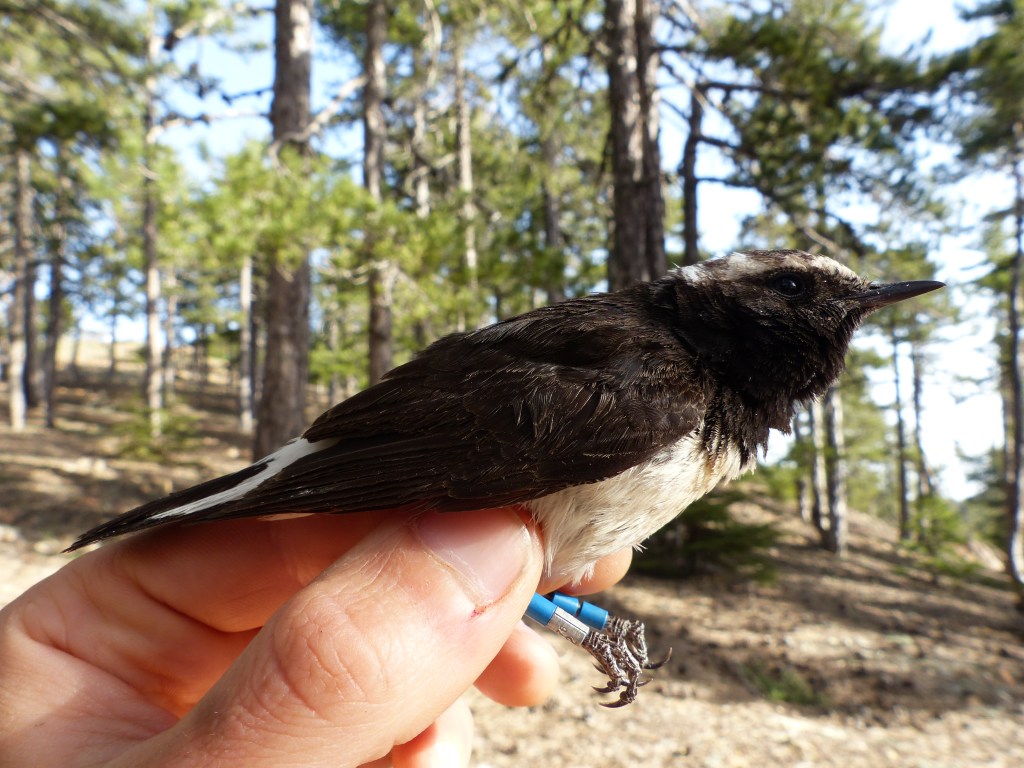
This work was the focus of my PhD and is supervised by Prof Will Cresswell.
Population trends of migrant landbirds
Many long-distance migrant bird species are declining. This is likely due to a combination of habitat loss and changing environmental conditions across breeding grounds, non-breeding grounds and stop-over locations. Over the past decade a large – and ever increasing – number of studies have been published that track migratory birds. By aggregating this data we can begin to investigate how migration patterns relate to population dynamics , and we can also use the population specific wintering locations to understand how human population change on non-breeding grounds relates to migrant bird population trends.
Estimating pollinator effectiveness
Flower visitation by insects (and other animals) is often used as a proxy for pollination, but visitation does not always lead to successful pollination, and so this measure may not be reliable. Single visit deposition (SVD) is another proxy for pollination that measures the number of pollen grains deposited by a visitor during a single visit to a flower and is thought to be a closer estimate of how effective different flower visitors are.
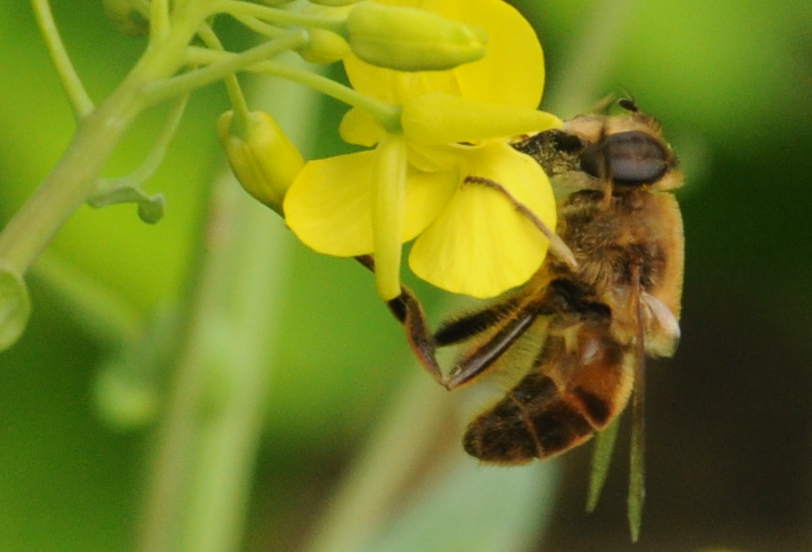
I have been involved in collecting SVD and visitation data for plant-pollinator network projects in Israel and Kenya, and for my undergraduate dissertation I investigated pollinator effectiveness by using SVD and pollen germination in the self-incompatible plant, Brassica rapa. While SVD is a more accurate measure of pollination than visitation alone, it may be biased by the presence of self-pollen being transferred within a flower during a visitation event. By counting the number of germinated pollen grains on the stigmas of a self-incompatible plant after a single visit we can eliminate this bias, since only outcross pollen can germinate. We found that the order of pollinator effectiveness was the same for both SVD and the pollen germination method, even though a large number of self-pollen grains were deposited on stigmas.
 Rob Patchett