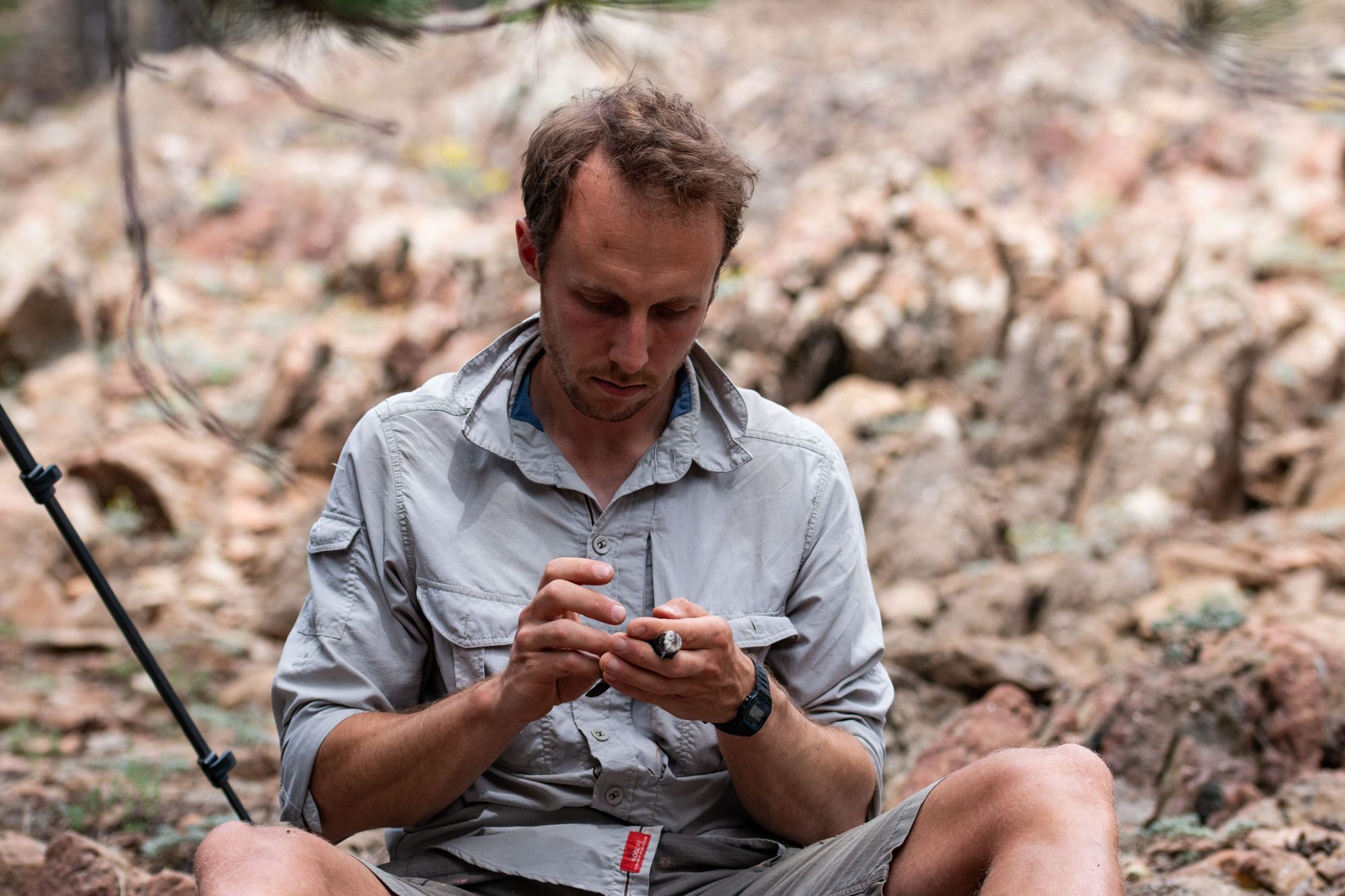
This is something that puzzles me each year. Common cuckoos can be heard in the Troodos area of Cyprus between April and June, and there were at least two pairs in our fieldsite this year. We heard them daily and saw them regularly, with their tight turns through the forest and various calls, from the classic ‘cuckoo’ call that the male makes to the more sinister ‘chuckle’ that the female makes when she lays an egg in a host’s nest. They are not confirmed as breeding in Cyprus, but probably do.
So who could the host be? Cyprus wheatear have been suggested as a possible host but at first seem an unlikely choice. Cyprus wheatears are cavity nesters, and cavities are in abundance around Troodos. The ground is covered with rocks of all sizes, providing perfect places for females to build their nests. They make a typical open-topped nest cup, and they are often very inaccessible, tucked away under rocks, occasionally the within the hollows of a dead tree and sometimes where the ground is lifted away by tree roots. Looking at the nests you wouldn’t think a cuckoo would be able to gain access to many of them. Outside of Cyprus, cuckoos have a range of hosts, famously parasitising the nests of dunnocks, reed warblers and meadow pipits, but they also target the common redstart. Common redstarts nest in cavities on the ground and fill a similar niche to the Cyprus wheatear. Researchers in Finland found that about 30% of common redstart nests at their fieldsite were parasitised, but only one third of those cuckoo eggs were laid directly into the nest cup. The other eggs were laid on incomplete nests, the nest rim or outside of the nest. So, cuckoos must have some difficulties laying eggs in cavities, but presumably enough success for it to be a successful strategy.

If Cyprus wheatears are a host here in Troodos then common cuckoos will have plenty of nests to choose from. We monitor between 50 and 70 territories in a typical year, and I’ve personally monitored over 120 Cyprus wheatear nests and not seen a single case of cuckoo parasitism. My PhD supervisor Will Cresswell and his student Marina Xenophontos observed a cuckoo chick being fed by a Cyprus wheatear a few years ago, but never directly in one of the 100 or so nests that they monitored over three years. Perhaps the cuckoos here are opportunistic and very rarely lay an egg in a wheatear nest, but still presumably have a target host species. I’ve only got one more year left in Cyprus and would really love to solve the mystery of who hosts the common cuckoo in Cyprus.
 Rob Patchett